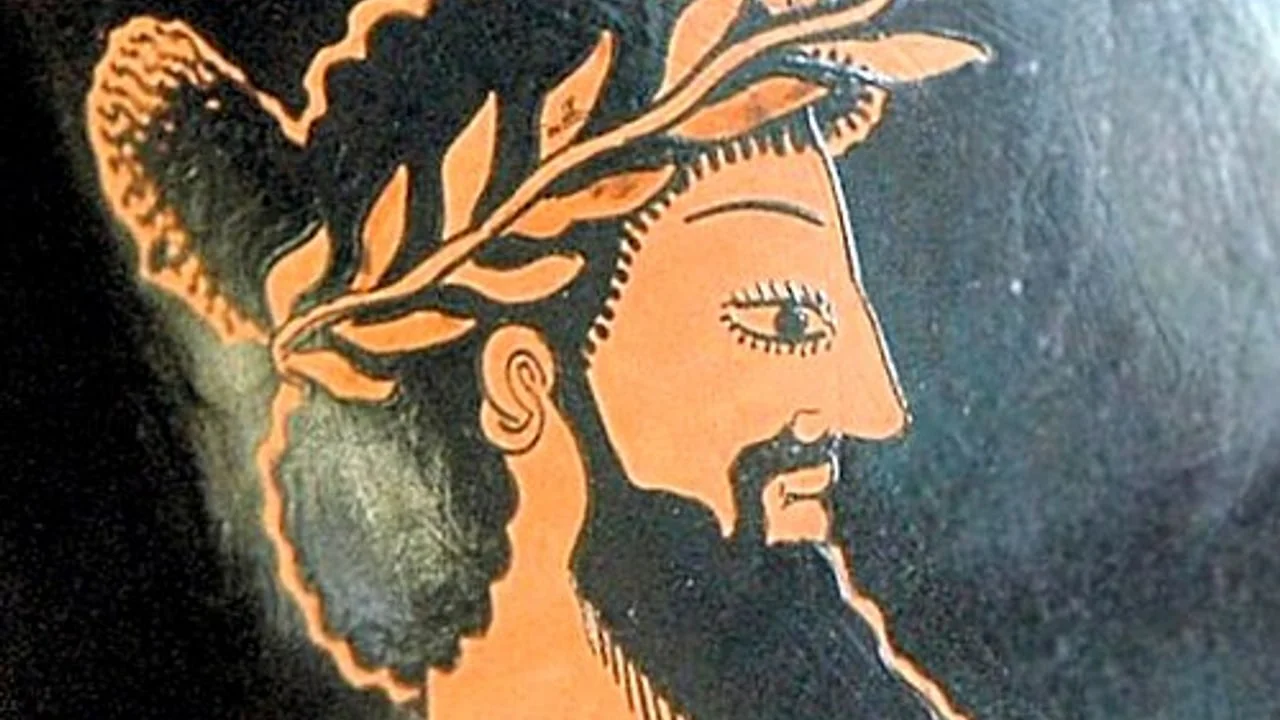
Krowisas: The Last King and the Oracle That Told the Truth
Croesus — whose Lydian name was Krowisas — was the fifth and final king of the Mermnad dynasty: the man who minted the world's first pure gold coins, built the richest empire in western Asia Minor, asked Solon the wrong question, and then discovered that the Oracle at Delphi had never deceived him at all. The fulfillment of Gyges's five-generation curse, told through the Pactolus refinery, the Solon conversation, and the night Sardis fell to Cyrus.
研究速览
The mint at Sardis smelled of salt and fire.
Somewhere beneath the citadel, in the workshops the archaeologists would uncover two and a half millennia later, workers pressed raw gold into thin sheets, then packed the gold with common salt and heated the mixture to eight hundred degrees. The silver dissolved away. What remained was purer than anything the Pactolus River had ever surrendered on its own — not the pale yellow electrum that Croesus's father had coined, not the mixed alloy that the first minters had stamped with a lion's head and called money, but something that glowed with a depth that electrum never managed: gold that was simply, completely gold.1
Croesus — his Lydian name was Krowisas, possibly a compound meaning "the noble Karoś" — came to the throne of Lydia around 561 BC after a succession struggle with his half-brother Pantaleon that Herodotus records but does not linger on.2 He had watched his father Alyattes rule for fifty years. He knew what an empire looked like. He also knew, because the priests at Delphi had been saying it since the time of his great-great-grandfather Gyges, that the Mermnad dynasty's good fortune carried a built-in expiration date. The fifth generation would pay for what Gyges had done to Candaules.
Croesus was the fifth king.
The richest man in the ancient world
He moved fast once the throne was his. Ephesus fell first — its ruling dynasty had backed Pantaleon in the succession fight and paid for it. City after city along the Ionian coast followed, from Miletus to Colophon, until Croesus controlled all of mainland Ionia, Aeolis, and Doris.3 He stopped at the Aegean shoreline. No navy, no island campaigns — but he made treaties with the island Greeks instead and collected tribute from trade that flowed through Naucratis in Egypt. East of Sardis, Phrygia was already Lydian territory, absorbed under Alyattes; Caria, where Croesus's own mother had been born, was brought under direct control. According to Herodotus, by the time Croesus had finished his campaigns, he ruled every people west of the Halys River except the Lycians and the Cilicians — roughly all of western Asia Minor.4
What made him extraordinary, though, was not the territorial breadth. It was the coins.
His father had minted electrum staters — beautiful, lion-stamped, and slightly unreliable in value because electrum is a natural alloy and its gold-to-silver ratio varies. Croesus solved this with the purification technology his workshops had mastered. He recalled the old electrum coinage and issued two new series: pure gold coins (Croeseids) and pure silver coins, bimetallic and separable for the first time.1 The gold stater weighed 8.06 grams. The design was sparse: on one face, a lion and a bull confronting each other head-to-head, forelegs extended — a Near Eastern motif the Lydian court had used for generations. On the reverse, two incuse punches. No inscription. The coin's authority came from its weight and its purity, both guaranteed by the king who issued it.
These coins traveled. Athens was still using weighed silver bullion; the Persians were still some decades from issuing the gold daric. Croesus's Croeseids became the dominant international trade currency of the Aegean world, and the Athenian treasury was still holding reserves of them in the fifth century BC, long after Lydia had ceased to exist as a kingdom.1 In 1922, American archaeologists excavating Sardis found a small ceramic pot containing thirty gold Croeseids — a hoard buried around 547 BC, probably when the Persians breached the walls. The coins sat undisturbed in the rubble for nearly two and a half thousand years.5
With the wealth the empire generated, Croesus gave to the gods. He dedicated a golden lion weighing ten talents to the sanctuary at Delphi — along with golden bowls, silver casks, a golden statue of his baker — and in return the Lydians received the right to consult the Oracle first, were exempted from sanctuary taxes, and were permitted to sit in the front rank at Pythian ceremonies.2 He sponsored the reconstruction of the Temple of Artemis at Ephesus, donating marble columns with his name inscribed at the base. One of those columns is in the British Museum now, bearing the inscription "Dedicated by Croesus" — the clearest evidence, apart from the coins, that the man historians later suspected of being largely legendary was entirely real.4
The sage who would not say what the king wanted to hear
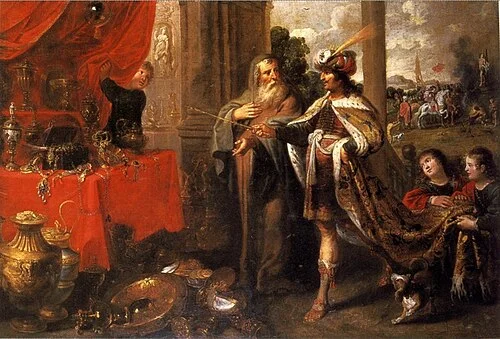
Herodotus says Solon of Athens came to Sardis during his years of voluntary exile from Greece. The Athenian lawgiver had given Athens its constitution, then left the city for a decade so that nobody could pressure him to repeal it — and he spent those years traveling Egypt and Asia Minor, collecting observations.
Croesus received him with every courtesy, showed him the storerooms and the treasuries and the counting-houses full of Croeseids, and then asked the question kings ask when they believe they already know the answer: Who is the happiest man you have ever met?
Solon named Tellus of Athens. A man who had lived well, raised fine children, died fighting for his city in a battle Athens won. Croesus, somewhat unsatisfied, asked for the second happiest. Solon named Kleobis and Biton — two brothers from Argos who had pulled their mother's ox-cart to a festival when the oxen were missing, were honored by the priests, and died peacefully in their sleep that night. Their mother had prayed for the gods to grant them whatever was best for men.
Croesus could not contain his irritation. And me? Am I nothing?
Solon answered him in a way that Herodotus renders without the slightest apology for its bluntness:
"In truth, I count no man happy until his death, for no man can know what the gods may have in store for him. He who unites the greatest number of advantages, and retaining them to the day of his death, then dies peaceably — that man alone, sire, is in my judgment entitled to bear the name of happy."4
Croesus dismissed Solon as a man whose cleverness exceeded his wisdom. He was wrong, and within a few years he knew it.
His son Atys — a young man he loved more than the empire — was killed on a boar hunt by a Phrygian exile named Adrastus who had come to Sardis seeking refuge and had accidentally killed his own brother before that. Croesus had sheltered Adrastus. He had even sent Adrastus on the hunt, thinking a trusted companion would keep Atys safe. The spear Adrastus threw at the boar went through his son instead. Adrastus killed himself on the tomb.2
Croesus mourned for two years. Then news arrived from the east that required his attention.
The oracle that told the truth
In 550 BC, the Median king Astyages — who was Croesus's brother-in-law, the man married to his sister Aryenis under the peace treaty that had ended the Lydo-Median war in 585 BC — was overthrown by his own grandson. The grandson's name was Cyrus. He was Persian. Within months he controlled everything east of the Halys.3
Croesus sent to Delphi. The oracle — and this is one of the most quoted statements in the entire Delphic record — told him: If you march against the Persians, you will destroy a great empire.
Croesus heard what he wanted to hear. He assembled allies: Nabonidus of Babylon, Egypt under Amasis II, and Sparta, which had just defeated Argos and which Croesus had supplied with gold for a statue of Apollo.2 He crossed the Halys River. According to Herodotus, Thales of Miletus — the same philosopher who had predicted the solar eclipse that ended Alyattes's war with Media in 585 BC — was serving as an engineer in Croesus's army and diverted the river into two fordable branches so the troops could cross.4
He was not crossing into someone else's disaster. He was walking into his own.
The fourteen days of Sardis
The Battle of Pteria was a draw. Both sides took losses; neither broke. Croesus assessed the situation and made a tactician's decision: withdraw to Sardis, consolidate allied forces over the winter, return with a larger army in spring. This was conventional. Armies in the ancient world did not campaign in winter.
Cyrus did not agree with that convention.
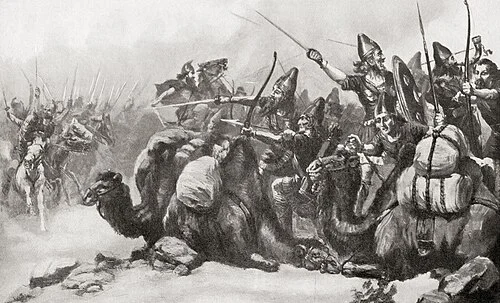
Rather than withdraw to his own winter quarters, Cyrus followed Croesus back west and engaged the Lydian forces at Thymbra before they could disperse. He had a solution to the thing that made Lydian cavalry terrifying in open battle — the horses were powerful, trained, and almost unbreakable in a charge. Cyrus mounted his baggage handlers on camels and put them at the front. The Lydian warhorses smelled the camels and stopped.4 The battle lasted long enough for Cyrus to win it decisively.
Croesus fell back into Sardis and sent out calls for help to his allies. The appeals never received answers. Nabonidus was watching his own frontiers. Egypt did not march. Sparta was occupied at home. The siege of Sardis lasted fourteen days.
The city fell when a Persian soldier noticed a Lydian soldier climb down the sheer north face of the citadel to retrieve a helmet that had fallen, and realized the supposedly impassable cliff was actually climbable. A small unit scaled it that night. By dawn Sardis belonged to Cyrus.
The pyre and what it taught a Persian king
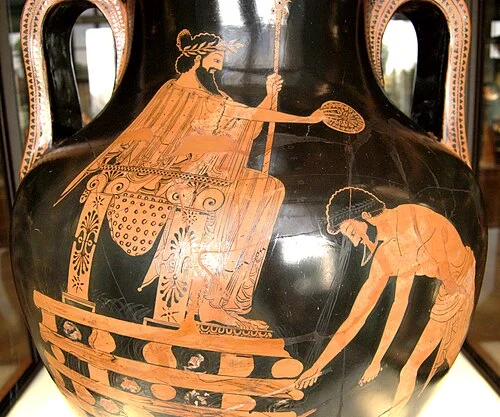
The punishment Cyrus decreed was burning. Croesus was to be executed on a funeral pyre along with fourteen noble Lydian youths — a demonstration, presumably, of what happened to kings who misread oracles and invaded Persian territory.
Herodotus and Bacchylides give the same scene in different registers: the pyre lit, the flames rising, and Croesus calling out — not to Apollo, not to any of the gods he had spent a fortune cultivating, but to a name. Solon. Solon. Solon.4
Cyrus heard the name repeated three times and asked a translator what word this was. Croesus told the story: the Athenian sage who had visited Sardis when everything was still good, who had refused to call him the happiest man in the world, who had said that no man could be called happy until his death because fortune can reverse at any moment. Cyrus, Herodotus says, was struck by this. He ordered the fire extinguished. A rain shower — miraculous in the ancient telling, perhaps merely fortunate in historical terms — helped put it out.
Croesus was kept alive. In most ancient accounts, he became an advisor to Cyrus and later accompanied Cyrus's son Cambyses II on the Persian campaign against Egypt. Ctesias says Cyrus gave him the governorship of Barene in Media.3 What is certain is that he survived the pyre — and that what he said about Solon appears to have genuinely moved the man who conquered him.
Croesus then sent to Delphi to complain: the Oracle had deceived him. The reply came back with the cold precision that Delphic answers always had in hindsight:
Not even a god can escape his ordained fate. Croesus has paid for the crime of his ancestor four generations ago, who, though a member of the personal guard of the Heraclidae, gave in to a woman's guile, killed his master, and assumed a station which was not rightfully his at all.4
The Oracle had told the truth. Croesus had destroyed a great empire. His own.
What the Sacred Blend left behind
The Mermnad dynasty ended with Croesus. The five generations that Gyges's oracle had prescribed — Gyges, Ardys, Sadyattes, Alyattes, Croesus — had run their course. The guilt that had entered the bloodline in that bedroom in Sardis, when a bodyguard killed a king at the request of a queen who had been made to feel ashamed, was now paid.
But the city itself did not simply vanish. Persian Sardis inherited the mint, the trade routes, and the administrative structures the Mermnads had built. The Croeseids continued circulating. The great refinery kept working. The four bloodstreams of the Sacred Blend — the ancient Anatolians who had farmed the Hermus valley since the Neolithic, the Indo-European speakers who had arrived with their horses and their language, the Caucasian metalworkers whose CHG ancestry the genetic record still shows, the Greek and later Roman populations who had traded and intermarried along the coast — did not cease to exist because a Persian army had taken the citadel. They went on being Sardians, under Achaemenid administration, then Seleucid, then Roman, each new regime arriving to find a city that already knew exactly how to absorb it.
The Oracle at Delphi had described the crime as something that required five generations to repay. It said nothing about the city. Sardis would outlast Persia, outlast Alexander, outlast Rome.
The purity that Croesus's refiners extracted from Pactolus gold outlasted everything. We still call it by his name.
Sources: sardisexpedition.org (John H. Kroll); Wikipedia/Croesus; Britannica/Croesus; World History Encyclopedia/Croesus (Joshua J. Mark, 2022); New York Times archive 1922; BBC Radio 4 "A History of the World in 100 Objects" — Gold Coin of Croesus; Herodotus, Histories I.
围绕这条内容继续补充观点或上下文。